
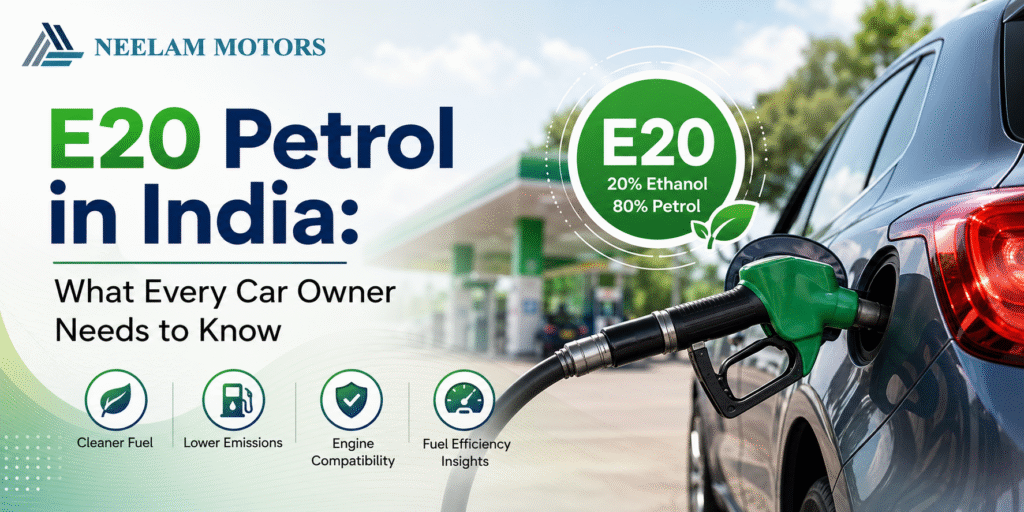
You’ve probably seen “E20” stamped on petrol pumps or heard it mentioned in the news. But what does E20 petrol actually mean for your car and your wallet?
In simple terms, ethanol is a clear, highly flammable liquid made by fermenting sugars from crops like sugarcane and maize (corn). E20 fuel means a blend of 20% ethanol and 80% petrol. This is part of India’s larger ethanol blending program, aimed at cutting pollution, supporting local farmers, and reducing dependence on expensive imported crude oil, all while offering a cleaner fuel option.
Types of Ethanol Blended Petrol Explained
Ethanol blends range from E5 all the way to E100. Modern cars handle small amounts of ethanol without issue, but older or vintage cars can face problems like rust or engine knocking if the wrong petrol ethanol mix is used.
Here’s a quick guide to how each blend affects your car:
E5 (5% Ethanol, 95% Petrol)
- Changes needed: None
- Compatibility: Virtually any petrol car built in the last few decades runs on E5 without issue. It behaves just like regular petrol.
E10 (10% Ethanol, 90% Petrol)
- Changes needed: None for modern cars; older classics may need caution.
- Compatibility: This is now the standard “regular” petrol in India, the US, UK, and much of Europe.
- Cars built after 2011: fully safe, no changes needed.
- Cars built before 2005: check your owner’s manual. A 10% blend can gradually degrade old rubber seals and fuel lines.
E15 (15% Ethanol, 85% Petrol)
- Changes needed: Depends on your car’s age.
- Compatibility: Cars from 2001 onward generally handle E15 safely. Older or heavy vehicles should avoid it, since it can cause overheating or trigger the “Check Engine” light.
E85 & E100 (85 to 100% Ethanol)
- Changes needed: Extensive.
- Compatibility: Not for regular cars. This fuel is reserved for Flex-Fuel Vehicles (FFVs), which have specially upgraded engines, fuel pumps, and sensors built to handle high alcohol content.
How Ethanol Blended Petrol Affects Your Engine
Because ethanol is an alcohol, it behaves differently from pure petrol:
- Rust and corrosion risk: Ethanol absorbs moisture from the air. In older cars with steel fuel tanks or rubber components, this can lead to rust and wear over time. Modern vehicles use stainless steel or plastic fuel systems specifically to avoid this.
- Fuel efficiency and mileage: Ethanol carries roughly 30% less energy than pure petrol. You won’t notice a difference at E5 or E10, but higher blends like E15 or E20 petrol can cause a small dip in mileage.
Why Is Brazil Ahead in Ethanol Fuel Production?
While India is just rolling out E20 petrol nationwide, Brazil has already pushed E85 ethanol blends to nearly 85% of its market. The US and Europe, by contrast, remain cautious, largely sticking with mandatory E5 and optional E15.
Three factors explain Brazil’s lead in ethanol fuel technology:
- Abundant raw materials. Brazil is the world’s largest sugarcane producer and third largest for corn, giving it a cheap, steady ethanol supply. The US and Europe grow plenty of corn too, but have chosen to prioritize electric vehicles (EVs) instead.
- An early start. Brazil began large scale ethanol blending in the 1970s, during the global oil crisis, backed by tax breaks and public awareness campaigns. The US, as the world’s top oil producer, never faced the same urgency.
- Regulatory caution. In Europe, strict regulations, safety concerns, and limited ethanol pump infrastructure have kept consumer confidence low, so E5 remains the norm.
India’s Ethanol Blending Program: Race to the Top
India is moving aggressively on its ethanol blending roadmap. Here’s how the E20 petrol rollout compares to other countries in Asia and Africa:
| Country | Standard Petrol Mix | Emission Norms | Market Status |
|---|---|---|---|
| India | E20 (E30 planned) | BS-VI (very strict) | Fast, highly planned rollout |
| China | E10 (select regions) | China 6b | Controlled, limited to farming zones |
| Australia | E10 | Euro 6d | Rapidly expanding |
| South Africa | E2 to E5 | Euro 2/3 | Slow growth, awaiting cleaner fuel norms |
| Ethiopia | E10 | Euro 2/3 | Successfully using local sugar waste |
As the world’s second largest sugarcane producer and third largest corn producer, India is well positioned to lead the global shift toward ethanol blended fuel. Key drivers behind the government’s ethanol policy include:
- Protecting consumers’ pockets. India’s ethanol journey began with a modest 5% blend trial in 2001, scaling up significantly after 2014 under the National Policy on Biofuels. The government has absorbed roughly ₹10,000 crore in tax revenue by keeping GST low on ethanol while holding petrol prices steady. Ethanol production capacity has now crossed 20 billion liters, comfortably meeting rising demand.
- Energy security and reduced crude oil imports. Ongoing geopolitical tensions in the Middle East and friction between major powers like Russia and the US make crude oil imports increasingly unpredictable. Domestic ethanol production reduces India’s exposure to global oil price shocks.
- Cleaner air and lower carbon emissions. E20 petrol is expected to cut carbon emissions by up to 10%, supporting India’s broader climate goals and BS-VI emission standards.
Real Challenges in India’s E20 Rollout
Ethanol brings clear benefits, but the ethanol blending program isn’t without hurdles:
- Older vehicles on the road. India’s large second hand car market includes many vehicles not built for E20 fuel. NITI Aayog has confirmed that lower blend petrol will remain available at pumps until these older cars are gradually phased out.
- Water intensive farming. Producing 1 liter of ethanol from sugarcane requires around 2,860 liters of water. NITI Aayog is working on incentives to encourage farmers to shift toward less water intensive crops like maize.
- Distribution bottlenecks. Ethanol production is uneven across states, and inter state transport is still hampered by regulatory friction, occasionally driving up local fuel prices.
- Pump level clarity. With multiple blends (E10, E20, and more) sold side by side, clear labeling at fuel stations is essential to prevent mix ups.
- Mileage trade off. E20 petrol does deliver slightly lower mileage compared to pure petrol. Automakers are actively redesigning engines to minimize this impact.
E20 Petrol Myths Busted
Myth: Once E20 is mandatory, normal petrol will disappear and I’ll have to scrap my old car. Fact: No. Lower ethanol or ethanol free petrol will continue to be sold for older vehicles. Premium zero ethanol fuels like XP100 or Power100 remain available too.
Myth: My car servicing and maintenance costs will rise because of ethanol. Fact: No. Routine service cost increases happen periodically regardless of fuel type. Ethanol blended petrol itself doesn’t add extra maintenance requirements for a compatible car.
Myth: Ethanol will rust my car engine. Fact: Only if you use an incompatible blend. Your fuel lid clearly states the maximum ethanol blend your car supports (E10, E20, and so on). Simply match it to the pump label.
Myth: CNG cars will have a shorter lifespan because of ethanol blending. Fact: No. CNG and petrol ethanol systems are entirely separate. As long as you fuel correctly, there’s no added risk.
Conclusion: Is E20 Petrol Good or Bad for Your Car?
E20 petrol represents the future of Indian fuel policy, and the country is well on track to lead the global ethanol blending movement. But like any major shift, its success depends on public understanding. Many car owners today remain unclear on why this change is happening and what it means for them, much like the early confusion around GST or the BS6 transition.
Unlike Brazil, where sustained public education built consumer confidence, India will need a stronger push through car dealerships, community outreach, and social media to close that gap.
The takeaway is simple: check your fuel lid, match it to the pump, and drive with confidence. E20 petrol doesn’t have to be complicated. It just needs a little awareness.